
Night on Bald Mountain, finished (mostly)
by Scott
Last week, I got sidetracked. I intended to work on my arrangement of Mussorgsky’s Pictures at an Exhibition, but with our October concert at Capilano University coming up, it seemed like a good idea to have something Halloween-appropriate on the program. So the same composer’s orchestral masterpiece Night on Bald Mountain came to mind!
This week, the arrangement is finished! I played through it at the piano for the first time and printed the score. However, after trying out the printed version, the small corrections started almost immediately, and there are always many changes to make, even after printing.
For example, the following passage has the woodwinds and strings playing continuous rapid staccato eighth notes for 12 bars. That is not too difficult on those instruments, but it can get tiring on the piano since we are playing chords instead of single notes.
An existing 4-hand arrangement by Artsybushev from the 1880s put continuous chords in both hands, but at the speed that most orchestras perform the piece, this is nearly impossible on the piano! I chose to alternate the two hands, playing two chords at a time. After trying my original arrangement at the piano, I found that the angle and stretch of the right hand (the primo usually sits quite far in the treble of the keyboard, so that the secondo can reach the pedals more easily) were too awkward. So I took out the lower voice to make it much more comfortable. I’m sure there will be many more similar discoveries as I play through multiple times!
Dividing chordal passages between the two hands is one of my most used techniques in 4-hand arranging, as they become easier to play and are often more powerful, since the whole arm is involved, rather than just fingers.
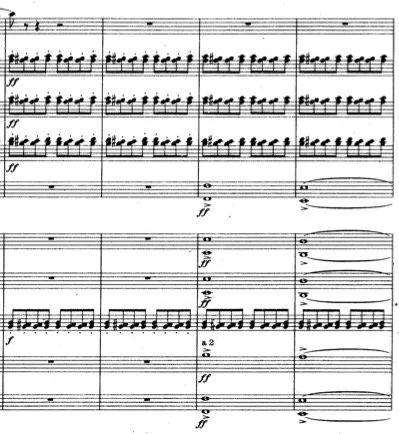
Orchestral full score
Lots of repeated staccato chords!
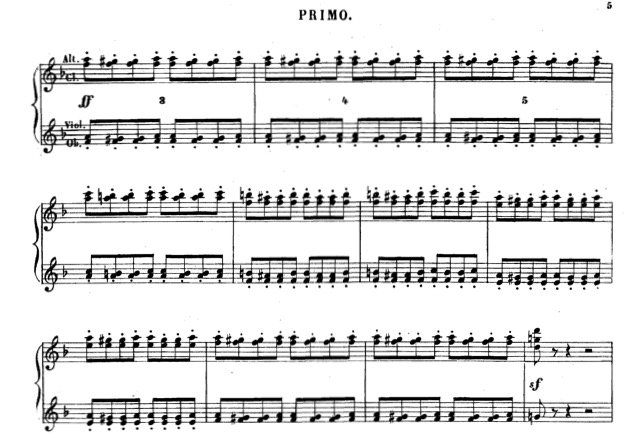
Artsybushev’s 4-hand arrangement is a literal transcription, but this is tiring to play on the piano.
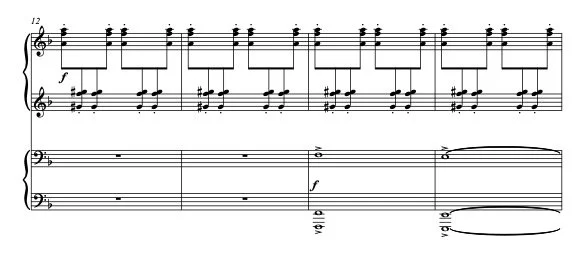
My original attempt
The right hand angle was more awkward than I thought.
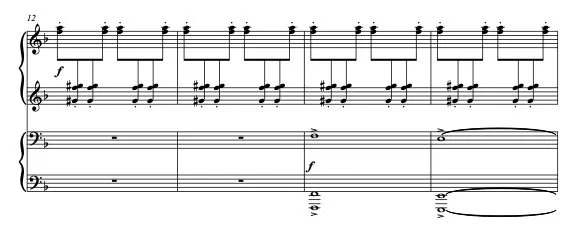
My revised version
By removing the bottom voice of the right hand, it solved the problem, and kept the original texture of the passage.
You might notice that I also adjusted the spacing of the four staves to make it more balanced on the page, but I failed to notice the off-center “f” in the secondo part! More edits to do!
Also, I changed the original fortissimo dynamic to forte, as the continuous eighth note pattern played fortissimo on the piano could quickly become obnoxiously loud (compared to woodwinds and strings playing fortissimo), and I wanted to save room for a crescendo at the end of the phrase. Similar adjustments often should be made when transcribing from orchestra to piano, to consider instrument tone, and orchestral sound color.
We are looking forward to learning this one properly for October. More on the program as it takes shape!